


Mountis
How can environmental data be made meaningful and engaging to foster shared understanding and collective action on climate change adaptation?
Climate change is transforming mountain regions, increasing pressure on natural resources and challenging the way communities anticipate and respond to environmental risks. Water management is particularly complex, involving stakeholders with different needs, priorities and perspectives.
While environmental monitoring technologies provide increasingly detailed information, access to data alone does not necessarily lead to understanding or action. The challenge lies in making this information meaningful, trustworthy and engaging for a wide range of audiences.
Mountis explores how environmental information can be translated into relevant and compelling experiences, connecting scientific knowledge with local perspectives to foster shared understanding and collaborative decision-making.
Developed as the Swiss demonstrator of MountResilience, a Horizon Europe initiative bringing together 47 international partners, Mountis focuses on the Val de Bagnes, a mountainous region in the Swiss Alps (Canton of Valais).
The territory illustrates the complexity of water management in mountain environments, where agriculture, tourism, energy production, ecosystems and local communities depend on the same resources, often with competing priorities. Climate change further intensifies these challenges, calling for more integrated and collaborative approaches.
Coordinated by the EPFL+ECAL Center, the project brings together scientific research, technological innovation and local expertise. Farmers, water managers, public authorities and citizens have been involved throughout the research and design process to identify relevant information, explore interactions and evaluate the platform in real-life contexts.
Translating complex environmental measurements into intuitive, contextualised and relative indicators helps diverse stakeholders build a shared understanding of their environment and engage in collective action.
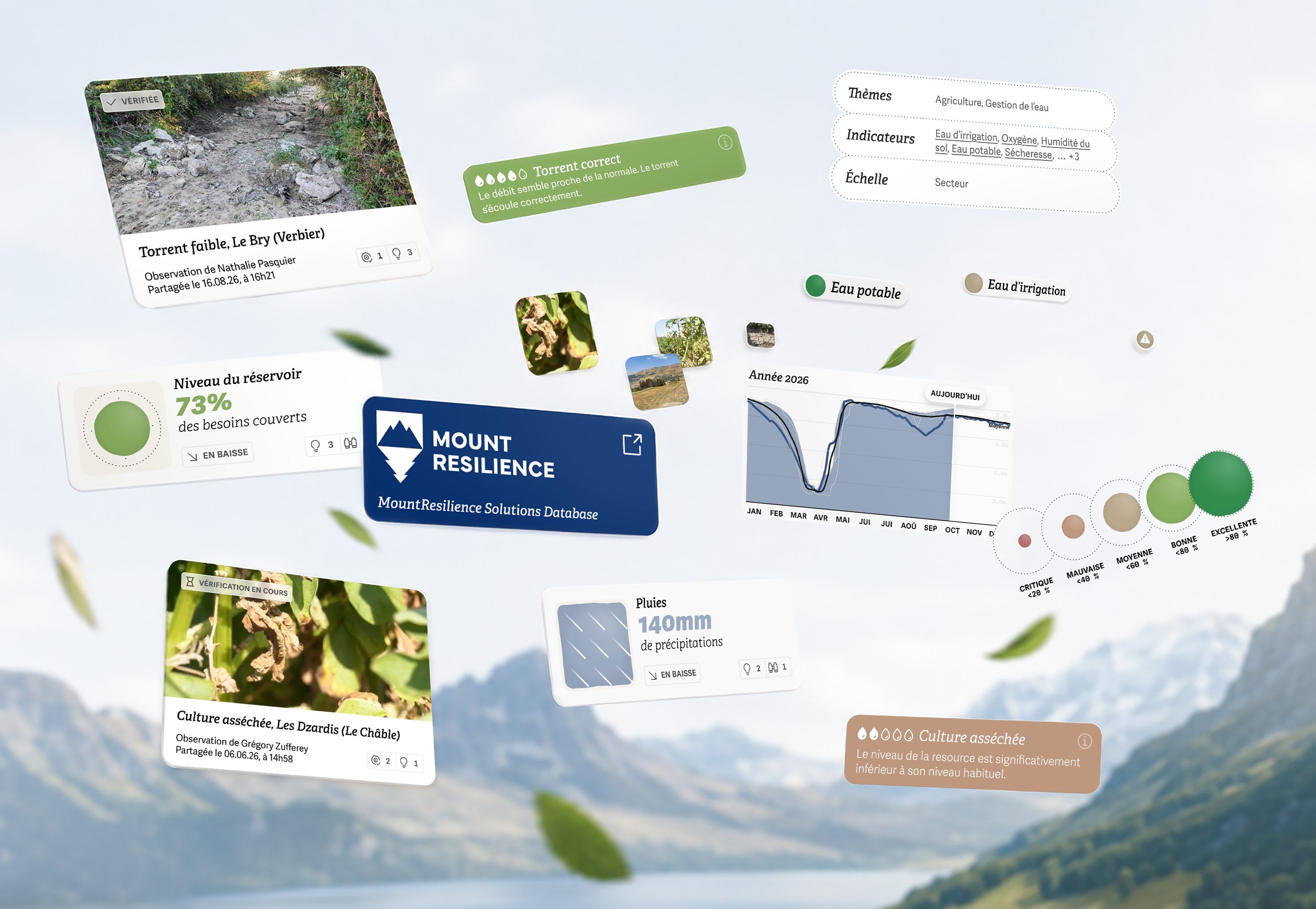
Mountis is a digital platform designed to create a direct connection between people and their environment, supporting a shared understanding of local water resources.
Using real-time measurements from sensors deployed across the territory, the platform translates complex environmental data into understandable indicators. Information on water quantity and quality, including water reserves, soil moisture and river conditions, is presented through interactive maps, historical comparisons and a harmonised visual language.
Beyond monitoring, Mountis enables citizens to contribute field observations and provides a catalogue of nature-based and other adaptation solutions. By combining scientific measurements with local knowledge, the platform connects environmental awareness with opportunities for action.
Developed through an iterative, human-centred design process involving local stakeholders, scientists and technology partners, Mountis proposes a new way of engaging with environmental information. Designed to be adaptable to other territories, it explores how digital interfaces can strengthen collective understanding and support more resilient communities.
Mountis will be launched on 9 November 2026 in Valais, Switzerland, during the annual meeting of the European MountResilience Consortium.
Developed over three years of interdisciplinary research and collaboration, the Swiss demonstrator marks the first implementation of a platform designed for potential replication in other mountain regions.
Direction & Coordination of the swiss Demonstrator
Art Direction & Project Management
research assistants
UX Psychology
Administrator
Photography credits
Images © EPFL+ECAL Center
Co-funded by the European Union under contract number 101112876. Views and opinions expressed are however those of the author(s) only and do not necessarily reflect those of the European Union or CINEA. Neither the European Union nor CINEA can be held responsible for them.
This work has received funding from the Swiss State Secretariat for Education, Research and Innovation (SERI).